| The
opening of the Guggenheim Museum
Bilbao |
| On Sunday,
October 19 1997, the Basque administration and the Solomon R. Guggenheim
Foundation opened the Guggenheim Museum Bilbao to the public. A series
of events starting October 3 leaded to the official opening on October
18 by the King of Spain. Designed by Frank O. Gehry and located in the
city of Bilbao in northern Spain, the museum is devoted to American and
European art of the 20th century. It is envisaged as an international center
of modern and contemporary art, and will extend the Guggenheim Museum's
efforts to bring its collections and programming to audiences around the
world. |
| The
project |
 |
Plans for a new cultural
institution for Bilbao date back to the late 1980s, when the Basque administration
began formulating a redevelopment program for the city. The administration's
goal was to diversify the city's economic base by building upon its traditional
shipbuilding and heavy manufacturing industries. A museum of modern and
contemporary art was conceived as a major element of this plan.
In 1991, Basque officials
approached the Solomon R. Guggenheim Foundation to propose that it participate
in Bilbao's redevelopment program. In December of that year, a preliminary
agreement was reached leading to the establishment of the Guggenheim Museum
Bilbao Foundation to manage the independent institution. On February 27,
1992 this agreement was formalized with an official agreement signed by
Basque President José Antonio Ardanza and representatives of the
Solomon R. Guggenheim Foundation.
|
| The
Building, a symbol of Bilbao |
 |
Gehry's design for the 24,000
m2 Guggenheim Museum Bilbao will serve as an architectural landmark recognizable
worldwide. The museum evokes not only the industrial vitality of Bilbao
but also the iconoclastic design of Frank Lloyd Wright's Solomon R. Guggeheim
Museum in New York.
The Guggenheim Museum Bilbao
is a collection of interconnected blocks housing galleries, an auditorium,
a restaurant, a museum store and administrative offices. These buildings
have as their central focus a single architectural composition. With its
towering roof, which is reminiscent of a metallic flower, the museum will
enliven the riverfront and serve as a spectacular gateway to the city.
|
| The
Solomon R. Guggenheim Foundation |
Gino Severini
Red Cross Train Passing
a Village, summer 1915
Solomon R. Guggenheim
Museum
New York
|
The mission of the Solomon
R. Guggenheim Foundation is to collect, preserve, research and present
works of modern and contemporary art in all its forms. Founded in 1937,
the Guggenheim Foundation has developed a comprehensive collection of 20th
century art and organised an extensive exhibition program.
The Guggenheim Foundation
currently oversees three major museums: The Solomon R. Guggenheim Museum,
designed by Frank Lloyd Wright and restored and expanded in 1992 by Gwathmey
Siegel & Associates; the Guggenheim Museum SoHo, designed by Arata
Isozaki and opened to the public in 1992; and the Peggy Guggenheim Collection,
located in Venice, Italy, and renovated and expanded in 1995 by Leila and
Massimo Vignelli.
|
| Bilbao,
a leading European City |
| The
Guggenheim Museum Bilbao is one of the most significant initiatives undertaken
in the city to meet the challenges of the European Union and the year 2000.
In addition to the new museum, Bilbao is also completing a number of projects
designed by some of the world's most renowned architects. Included in the
city's redevelopment plans are: a new subway system designed by Sir Norman
Foster, which opened in November, 1995; the reconstruction of the city's
airport and construction of the Uribitarte Footbridge over the Nervion
River by Santiago Calatrava; and a waterfront development by Cesar Pelli.
The waterfront project, which will be adjacent to the Guggenheim Museum
Bilbao, will include the conversion of former shipyard into parks, apartments,
offices and shopping areas. |
| The
Guggenheim Museum Bilbao |
Willem de Kooning
Villa Borghese, 1960
Guggenheim Bilbao Museoa
|
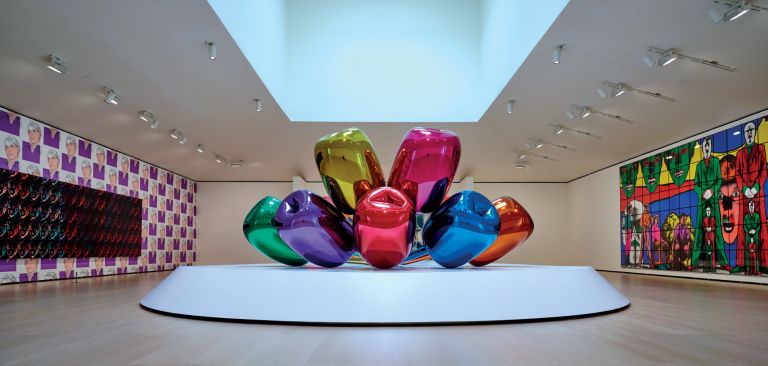
The Guggenheim Museum Bilbao
opens its doors with the threefold mission of bringing together and interpreting
the most representative art of our time, fostering artistic education and
the public's knowledge and understanding of the arts, and complementing
the extensive collection of the Solomon R. Guggenheim Foundation. The Guggenheim
Foundation, founded in the twenties by Solomon R. Guggenheim and his artistic
advisor Hilla Rebay, has collected objects produced in the twentieth century
from the full range of Western visual arts. This magnificent collection
is distributed in three museums managed by the Foundation: the Solomon
R. Guggenheim Museum, the Guggenheim Museum SoHo, both in New York, and
the Peggy Guggenheim Collection, in Venice. Now, the unique collaboration
between the Basque Administration and the Solomon R. Guggenheim Foundation
has made possible one of the most ambitious cultural projects of our time,
the Guggenheim Museum Bilbao.
The permanent collection
of the Guggenheim Museum Bilbao basically includes works by the most prominent
artists of the last forty years of this century, and is supplemented by
works from the Solomon R. Guggenheim Foundation -significant examples of
Pop Art, Minimalism, Arte Povera, Conceptual Art and Abstract Expressionism
among others- and by special programming sponsored by the Foundation. Further,
a number of rooms at the Guggenheim Museum Bilbao are devoted to in-depth
installations and other to site-specific works specially commissioned for
this Museum. Basque and Spanish contemporary art is also represented by
a selection of works by the best artists in the field. Together they provide
a satisfying overview of the latest trends in our contemporary art.
|
| The
Guggenheim Museum Bilbao, a masterpiece of twentieth century architecture |
|
From the beginning, the
architecture of the building that would eventually house the Guggenheim
Museum Bilbao was recognized as a decisive factor in making the project
the international landmark of artistic excellence it was designed to be.
This approach continued the tradition begun by the Solomon R. Guggenheim
Foundation when it commissioned Frank Lloyd Wright to design the original
museum on New York’s Fifth Avenue. Frank O. Gehry was entrusted with the
task of designing the Guggenheim Museum Bilbao, largely because his conceptions
reflected the project's enormous potential by integrating the building
into the fabric of the city of Bilbao and into its ongoing urban regeneration
plan.
Gehry’s huge sculpture-like
building is fashioned from a surprising array of materials and endowed
with an extraordinary, unmistakable silhouette. Under the apparent chaos
caused by the juxtaposition of fragmented volumes with regular forms finished
in stone, curved forms covered with titanium and huge glass walls, the
building revolves around a central axis, the atrium, a monumentally empty
space crowned by a metal dome. Daylight floods in through the glass walls
and the skylight set high up in the dome. Leading off from this central
space, a system of curved walkways, glass lifts and stairways connect 19
galleries that combine classical, rectangular spaces with others of unusual
proportions and forms. The wealth and variety of spaces makes the museum
exceptionally versatile. The notion of the collection as encyclopaedic
overview is reflected in the chronological distribution of the works in
rectangular galleries housed in the regular, stone-covered volumes. This
overview is complemented by the in-depth spaces devoted to specific artists,
for whose work 9 galleries of special forms and spectacular dimensions
are reserved in the titanium-finished volumes. Temporary exhibitions and
large-format works are housed in an exceptional, 30 metre wide gallery
which stretches along nearly 130 metres of column-free space located in
the impressive volume that runs under the imposing La Salve bridge. This
space culminates in a tower which integrates the bridge itself into the
intersection of volumes that configure the building. |